 Mechanical Filtering
Helmholtz Resonators
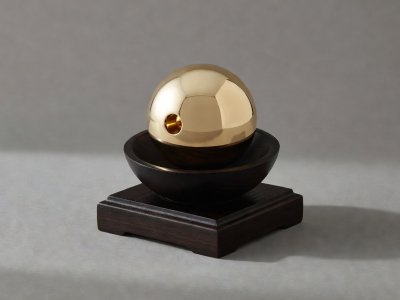
Long before electronic spectrum analyzers existed, Helmholtz held hollow glass and brass spheres of graded sizes against his ear to isolate individual overtones inside musical chords.
In his 1863 treatise On the Sensations of Tone, Hermann von Helmholtz drew a sharp boundary between physical acoustics (pressure waves in elastic media) and physiological acoustics (how the cochlea and brain interpret those waves). Understanding that boundary dissolves the mystery behind every audio illusion.
A pocket smartphone speaker is physically too small to move enough air at 100 Hz to reproduce the fundamental frequency of a bass guitar or cello. Yet when you listen to a recording on a phone, you can still follow the bass melody effortlessly. Why?
When a string vibrates at a fundamental of 200 Hz, it also radiates integer overtones at 400 Hz, 600 Hz, 800 Hz, and 1,000 Hz. Even if a filter completely removes 200 Hz and 400 Hz, the upper harmonics remain spaced by exactly 200 Hz. The central auditory system acts as a harmonic template matcher, recognizing the 200 Hz periodicity and assigning a clear 200 Hz virtual pitch.
Start the harmonic stack below. Notice how the chord does not sound like a high 600 Hz whistle; instead, it carries the low fundamental pitch of a 200 Hz buzz:
Generator idle. Ready for listener-started playback.
Inside the snail-shaped cochlea, the basilar membrane acts like a mechanical frequency analyzer: high frequencies peak near the stiff base, while low frequencies travel to the flexible apex. Harvey Fletcher’s work at Bell Labs showed that frequencies falling within the same narrow neighborhood—a critical band—compete for the same hair cells, causing acoustic masking (the very principle behind MP3 and AAC perceptual audio coding).
In 1990, psychologist Albert Bregman synthesized decades of experiments into Auditory Scene Analysis. Just as the visual system groups dots and lines into distinct objects, the auditory system groups sound components into streams using two main clues:
Mechanical Filtering
Long before electronic spectrum analyzers existed, Helmholtz held hollow glass and brass spheres of graded sizes against his ear to isolate individual overtones inside musical chords.
 Equal Loudness
Turn a stereo down late at night and the bass and treble seem to vanish first. Our hearing sensitivity peaks between 2 kHz and 5 kHz due to the natural acoustic resonance of the human ear canal.