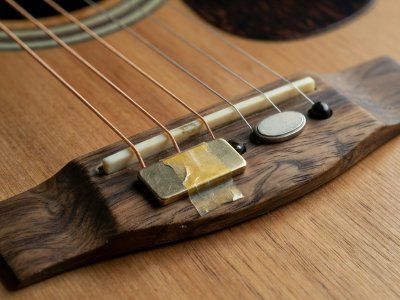
Our ears evolved to listen to vibrations traveling through air. The moment you press your ear—or a brass contact transducer—directly against solid steel, taut wire, or a mug of aerated liquid, the rules of wave speed and harmonic decay change dramatically.
Experiment 3.1 · Acoustic Dispersion in Solids
Why a Stretched Spring Sounds Like a Sci-Fi Blaster
In open room air, the speed of sound is practically identical for a 100 Hz bass note and a 4,000 Hz piccolo note. If that were not true, sitting in the back row of a concert hall would smear every orchestral chord into a muddled glissando.
Inside a coiled steel spring (such as a classic metal Slinky), flexural bending waves behave very differently: they are dispersive. High-frequency vibrations race down the helical coils much faster than low-frequency vibrations. When sound designer Ben Burtt attached a pickup to a taut guy-wire in the 1970s and struck it with a wrench, the high frequencies arrived at the microphone first, followed milliseconds later by a sweeping tail of lower frequencies—creating the iconic cinematic laser chirp without a single digital synthesizer.
Listen to how inharmonic overtones (frequencies that are not whole-number multiples of the fundamental) give metal bowls and springs their unmistakable chime:
Generator idle. Ready for listener-started playback.
Experiment 3.2 · Kitchen Acoustics & Room Modes
The Hot Chocolate Effect & Room Loops
Documented by UC Berkeley physicist Frank S. Crawford in 1982, the Hot Chocolate Effect (also called the allasonic effect) is an experiment you can run in sixty seconds at home:
Fill a tall ceramic mug with hot water and add two spoonfuls of instant cocoa, coffee, or fine salt that traps tiny air bubbles.
Stir briskly and tap the inside floor of the mug rapidly and continuously with your metal spoon.
Immediately after stirring, the tap sounds surprisingly low and dull. Over the next ten seconds, as the microscopic bubbles rise and pop, the pitch of your tapping climbs steadily by more than an octave!
Why it happens: Water is nearly incompressible, so sound travels through pure water at roughly 1,480 m/s. Introducing even 1% air bubbles by volume gives the fluid the compressibility of air while retaining the heavy mass density of water. The speed of sound inside the mug plummets to a fraction of its normal value, stretching the wavelength of the vertical standing wave inside the liquid column.
Modal Node Mapping
Alvin Lucier’s Room Resonance (1969)
In his landmark work I Am Sitting in a Room, composer Alvin Lucier recorded a spoken paragraph, played it back into the room, and re-recorded it 32 times until speech dissolved into the room’s pure resonant frequencies.
Impedance Matching
Getting Bass Out of Contact Mics
Why do cheap piezo discs often sound tinny? A piezo element is capacitive; plugging it into a standard 3 kΩ mic input forms a high-pass filter. Using a 1 MΩ to 10 MΩ instrument buffer restores deep sub-bass resonance.
 Modal Node Mapping