Cabinet Wing II · Spatial Psychoacoustics

Binaural: Hear the Space Between Channels

Put on headphones and listen to a dummy-head recording of a matchbox being shaken behind your neck: many listeners instinctively duck or turn around. Yet play that exact same stereo file over laptop speakers and the three-dimensional sphere flattens into the desk.

Observation 2.1 · Lord Rayleigh’s Duplex Theory (1907)

Microseconds and Head Shadows

Unlike the retina of the eye, which maps spatial position directly across millions of photoreceptors, the inner ear’s basilar membrane is arranged by frequency. To figure out where a sound originates in a room, the brain compares two subtle discrepancies between the left and right ears:

  • Interaural Time Difference (ITD): Because average human ears sit roughly 17 to 18 centimeters apart, a sound arriving from 90 degrees to the left reaches the left eardrum about 650 microseconds (0.00065 seconds) earlier than the right. Below 1,500 Hz, neural phase-locking tracks these tiny arrival gaps with remarkable precision.
  • Interaural Level Difference (ILD): Above 1,500 Hz, sound wavelengths become shorter than the diameter of the human skull. The head acts as a physical barrier, casting an acoustic shadow that attenuates high frequencies at the far ear by up to 20 dB.
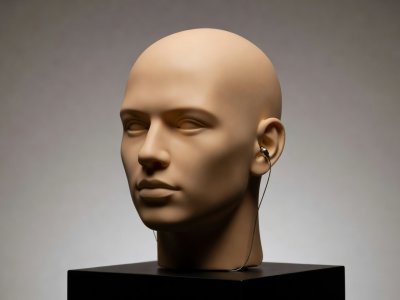
Sculpted acoustic dummy head with miniature omnidirectional capsules mounted inside molded silicone ears HRTF Capture

Why Pinna Folds Matter for Height

Time and level differences between two ears cannot distinguish directly in front from directly behind (the "cone of confusion"). The ridges of your outer ear (pinna) introduce tiny spectral notches above 4 kHz that encode elevation.

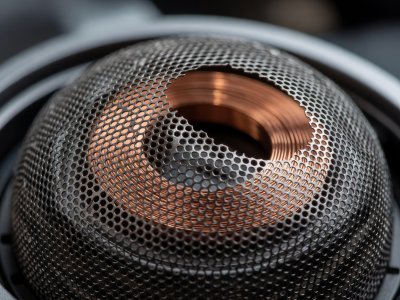
Macro view of an open-back headphone copper voice coil through perforated metal mesh Channel Crosstalk

Why Speakers Collapse Binaural Audio

With loudspeakers, the left speaker’s sound reaches both your left ear and—half a millisecond later—your right ear. That room crosstalk overwrites the delicate head-shadow cues captured by dummy-head microphones.

Observation 2.2 · Acoustic Beats vs. Binaural Beats

Demystifying 250 Hz and 256 Hz

Few audio topics attract more exaggerated claims than binaural beats, first noted by Prussian physicist Heinrich Wilhelm Dove in 1839. Let us look calmly at what actually happens in the signal and the nervous system:

When two tuning forks at 250 Hz and 256 Hz ring together in the same room, their sound waves physically add and cancel in the air six times per second. A microphone placed anywhere in the room records a fluctuating 6 Hz amplitude envelope—an acoustic (monaural) beat.

When 250 Hz is fed exclusively to the left headphone cup and 256 Hz exclusively to the right cup, no physical mixing occurs in the air. Instead, phase-sensitive neurons in the brainstem compare the drifting phase relationship between the two ears, producing a subtle, centralized wavering sensation known as a binaural beat. While it is a fascinating window into low-frequency neural phase locking (typically effective only below 1,000 Hz), it is simply an interaural phase cue—not a medical treatment or guaranteed mood switch.

Explore Tabletop Recording Experiments