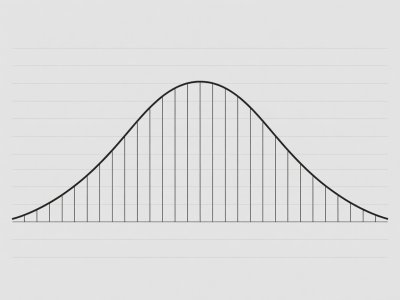
 Spectral Envelope
Fixed Bell Curve, Moving Chroma
While individual sine components march upward in frequency, the outer amplitude envelope remains stationary around 500 Hz. The brain tracks local steps rather than global drift.
Listen to a four-word spoken phrase repeated eight times in a row: suddenly, without a single alteration to the audio file, the speaker seems to break into melody. Auditory illusions reveal the shortcuts our nervous system takes to make sense of crowded acoustic environments.
When Roger Shepard programmed an IBM 7094 computer at Bell Laboratories in 1964 to generate complex tones made of up to ten octave-related sinusoids, he separated pitch into two independent dimensions: chroma (the circular note class, such as C or F♯) and height (the overall spectral envelope fixed by a bell-shaped filter). Four years later, French composer Jean-Claude Risset glided that pattern into a continuous glissando that seems to fall or rise eternally.
In 1986, perceptual psychologist Diana Deutsch took this principle further with the Tritone Paradox. When two Shepard tones separated by exactly half an octave (six semitones, or a tritone) are played one after another, the physical distance up or down the circle is identical. Remarkably, listeners in one region or family often agree that a given pair steps upward, while other listeners sitting in the very same room hear the exact same pair step downward.
Spectral Envelope
While individual sine components march upward in frequency, the outer amplitude envelope remains stationary around 500 Hz. The brain tracks local steps rather than global drift.
 Dichotic Competition
When Ear L receives 400-800-400-800 Hz while Ear R simultaneously receives 800-400-800-400 Hz, listeners rarely hear both streams; instead, pitch follows one dominant ear while location follows the high tone.
Speech perception is not a passive microphone transcript; it is an active guessing game. Consider three classic demonstrations where linguistic processing overrides raw waveform data:
The Observation: Take an ordinary spoken phrase—famously the words "sometimes behave so strangely"—and loop those four words ten times without changing pitch or timing. By repetition five or six, the spoken cadence transforms into a vivid musical tune.
The Signal & Explanation: Normal speech already contains rich fundamental frequency (F0) contours, but our brain suppresses awareness of exact musical intervals so we can focus on word meaning. Exact repetition saturates semantic processing and unmasks the latent melodic pitches.
The Observation: Viral short audio clips (such as the famous 2018 dictionary recording split) cause half a room to hear one two-syllable word while the other half hears a completely different word.
The Signal & Explanation: No magic happens in the file. Instead, degraded mid-band audio blends two competing formant patterns. Listeners whose speakers, headphones, or ears emphasize energy above 2,500 Hz lock onto the higher formant trajectory, while listeners receiving stronger energy below 1,000 Hz lock onto the lower trajectory.
The Observation: Watch a silent video of a speaker mouthing the velar syllable "ga-ga" while the audio track plays the bilabial syllable "ba-ba". Most observers hear a third compromise syllable—"da-da"—that is neither on the soundtrack nor on the lips.
The Signal & Explanation: Close your eyes and the audio immediately reverts to "ba-ba". The superior temporal sulcus integrates visual lip closure with acoustic formant transitions before conscious perception occurs.
Want to test how separate left and right channels create spatial illusions? Continue to Binaural: Hear the Space Between Channels.